
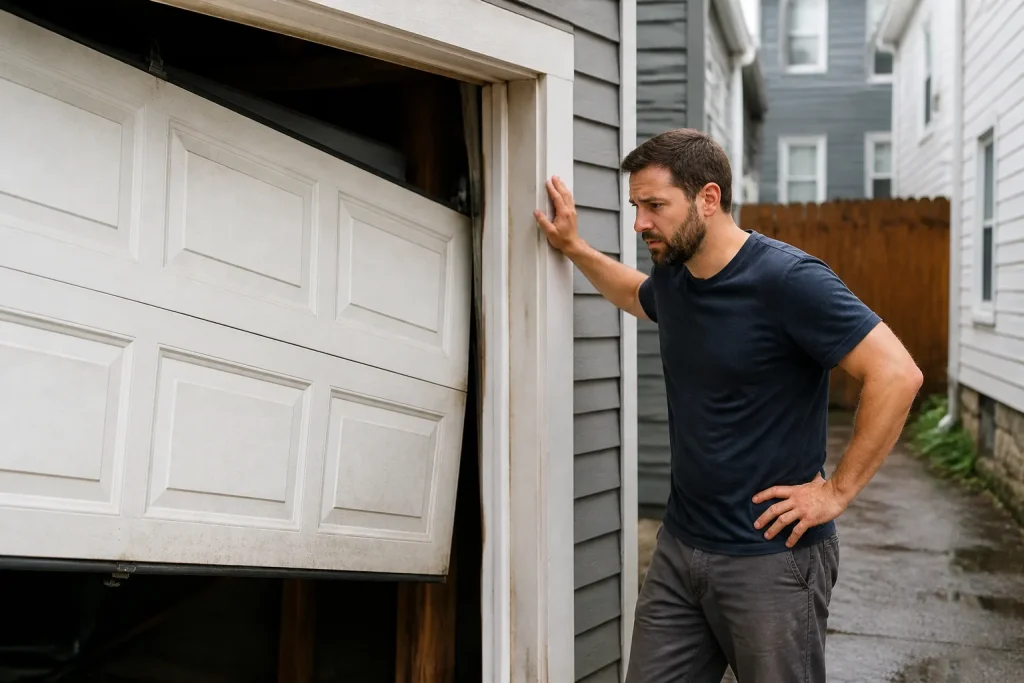
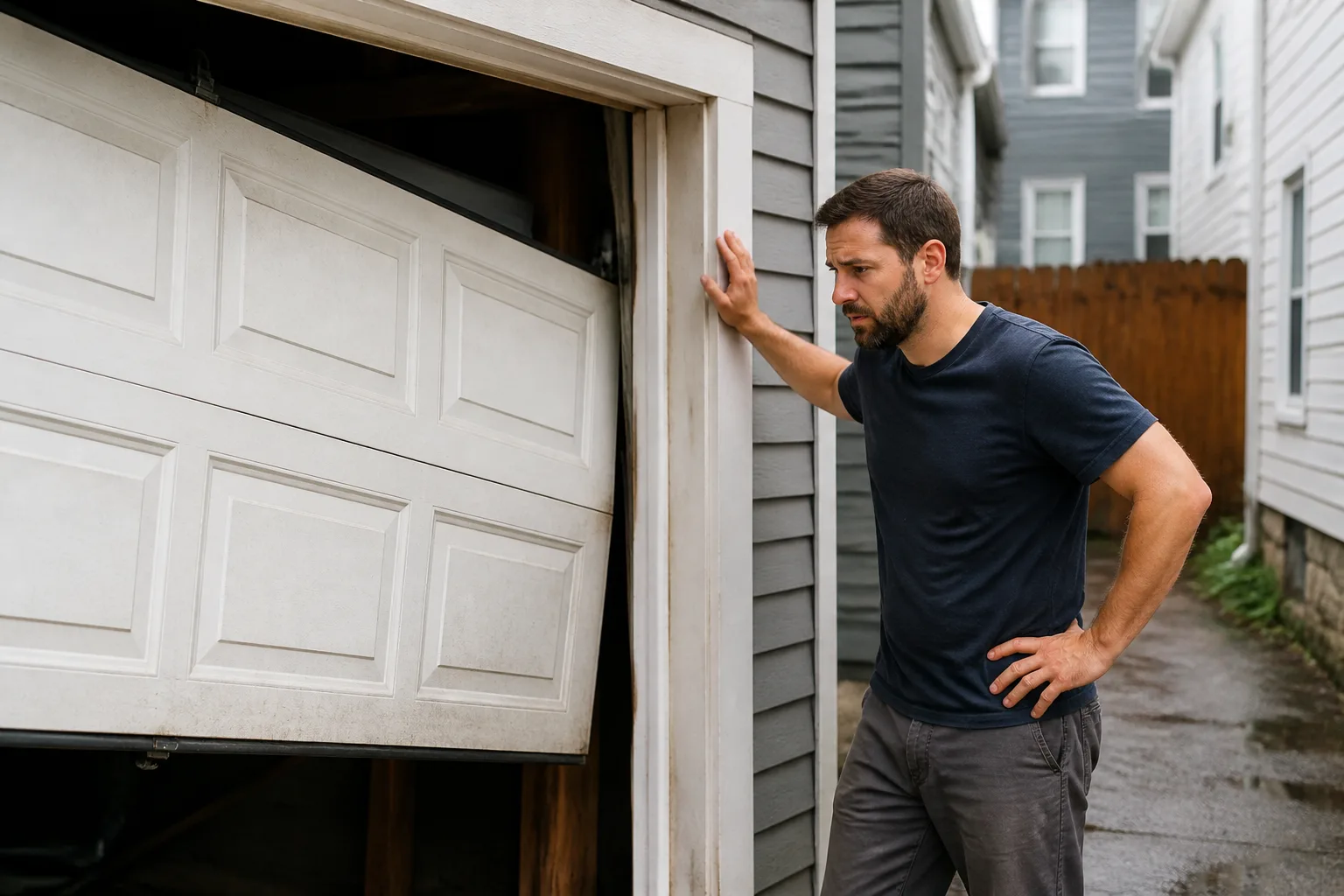
Emergency Garage Door Repair Near Me: What South Boston Homeowners Should Do First
A broken torsion spring under tension holds roughly 100 to 200 lbs of stored force. Touching it without knowing that is how a minor inconvenience becomes an emergency room visit. Most emergency garage door calls in South Boston go sideways before a technician even arrives, because homeowners reach for the wrong fix first. The first ten minutes after a failure are a damage-control window, not a DIY opportunity. If you’d rather not troubleshoot it yourself, call (844) 662-2561. We answer 24/7. Fast dispatch from 7am to 7pm, Sunday through Friday.
What Should You Check First When a Garage Door Fails?
Stop, look, and listen – and keep your hands off the springs, cables and brackets. Most failures announce themselves visually, and you can sort out which type of problem you have without touching a single moving part. Stand inside the garage, look up, and take thirty seconds to read the door before you do anything else. This one habit prevents most of the injuries and extra damage we hear about.
Run through this visual checklist:
- Look at the springs. Torsion springs sit on a metal shaft above the door. A clean gap in the coil means the spring has snapped. Extension springs run alongside the tracks and stretch when the door closes. A stretched-out, dangling or visibly kinked extension spring has failed.
- Check the cables. The thin steel cables run along each side. A cable off its drum or hanging loose means the door has lost its lift support on that side.
- Watch the door travel. If the opener hums but nothing moves, or the door goes up a foot and stops, the opener or its drive is the suspect. If the door moves unevenly or grinds, look at the rollers and track.
- Inspect the tracks. Bent, kinked or separated track sections are visible from the floor. Never try to bend track back into shape while the door is on it.
- Listen for the motor. A clicking relay or dead silence points at the opener, not the door.
The pattern matters more than any single clue. A snapped spring plus a door that won’t budge points one way. A door that moves but derails points another. That distinction is exactly what a technician needs to hear when you call, and it’s what keeps the diagnosis quick.
Why Is Manually Releasing a Broken Door Dangerous?
Pulling the red release handle on a broken garage door can send it crashing down. The opener’s release cord detaches the door from the motor, and the door is then held only by its springs and cables. If a spring has snapped or a cable has failed, nothing is holding the weight. That’s when a door free-falls, and a sectional door is heavy enough to cause serious injury or wreck the panels, the tracks, and whatever is parked underneath.
Here’s the rule we give homeowners in South Boston: if you suspect a broken spring or cable, leave the door where it is. Don’t pull the release. Don’t try to lift the door by hand to check. Don’t prop it open with a broom or a ladder. A door held up by a prop is a door waiting to come down.
If the door is already stuck open and you need to secure the building, the safer move is to leave the door in place and treat the opening as unsecured until a technician arrives. Springs and cables are under constant tension, and the high-tension torsion assembly at the top of the door is the single most dangerous part of the whole system. This is one of the reasons spring work is a specialty, not a general handyman task. Our technicians handle it as a standard repair because it takes the right tools and the right knowledge to do it safely, brand by brand – Genie, Clopay, Amarr, Wayne Dalton, and the rest of the major platforms.
How Do South Boston Logistics Affect Emergency Repair?
South Boston’s street layout changes how fast a repair can happen. Narrow driveways in the older residential blocks mean a technician may not be able to pull a vehicle close to the door. Shared parking structures – common in the denser parts of the neighborhood – can have low clearance, tight turns, and a single entrance, which slows access. Street permit zones and resident parking rules around the neighborhood also matter: if your driveway is blocked or your alley is a tight squeeze, tell the dispatcher when you call.
A few local realities worth planning around:
- Narrow driveways and older homes. Many South Boston garages were built for smaller cars and tighter clearances. Panel size and track configuration come up early in the diagnosis.
- Shared and underground parking. Property managers in South Boston often need the repair timed around resident access, and the door may serve several units.
- Permit zones and street parking. If your garage opens onto a permitted block, plan for where the service vehicle can legally stop.
- Row-house proximity. A door that won’t close affects neighbors in attached homes too, which raises the urgency.
None of this is a reason to panic. It’s a reason to give clear details on the phone so the first visit is the right visit. For a closer look at how we handle repairs across the neighborhood, see our garage door repair service.
What Information Should You Have Ready Before You Call?
Have your door brand, opener brand, and a one-sentence description of the failure ready before you dial. That single step can cut the diagnostic time in half. Technicians who already know the system they’re walking into can bring the right parts on the first visit instead of guessing.
Here’s the list we ask for when a South Boston homeowner calls:
- The door brand and material. Is it steel, wood or aluminum? Clopay, Amarr and Wayne Dalton all have model-specific parts, and knowing the brand narrows the diagnosis fast.
- The opener brand and model. LiftMaster, Chamberlain, Genie, Craftsman and Raynor all come with their own quirks. If you have a Wi-Fi or smart-enabled opener, mention it – the fix and the app reconnect are different from a legacy unit.
- What the door is doing. Won’t open at all, opens partway, reverses immediately, won’t close, or makes a grinding noise. Each one points to a different component.
- Whether anything is trapped. A car inside, a pet, or a person who can’t get out. This changes the priority of the call.
- Access details. Driveway width, parking structure clearance, gate codes, and where a service vehicle can legally stop.
- Your contact and address. Sounds obvious, but having it ready saves a back-and-forth.
If you can photograph the broken part from a safe distance – no climbing, no reaching – send it along. A clear photo of a snapped spring or a kinked track saves a lot of questions. For opener-specific problems, our garage door opener repair page covers the common failure modes across the major brands.
When Is a Door That Won’t Close a Security Risk?
A garage door that won’t close leaves your home open to the street, and that’s the one scenario where waiting for a technician needs a plan in between. A stuck-open door is a standing invitation in any neighborhood, and in South Boston’s dense blocks, an open garage is visible to anyone walking past. If you can’t secure the opening, act on the interim steps while you wait for the repair.
What to do in the meantime, safely:
- Don’t force the door down. If a spring or cable has failed, pushing the door closed can drop it or damage the panels further.
- Secure the opening from inside. Park a vehicle close to the opening if you can do it without blocking the door’s path, and keep interior doors to the house locked.
- Move valuables out of the garage. Tools, bikes and anything visible from the street are better inside the house until the door is fixed.
- Tell a neighbor. In a dense South Boston block, a neighbor keeping an eye on the opening is a real deterrent.
- Call and describe the security situation. A door that won’t close is a different priority from a door that won’t open, and the dispatcher needs to know.
Never wedge the door with a ladder or a board and walk away. If that prop slips, the door comes down hard. This is a job for a technician with the right parts – and if your door is older or a specific brand like Wayne Dalton or Clopay, the right part matters. Our technicians have up to 10 years of experience across eight major brands, and we carry the common components so a same-visit repair is often possible.
When Should You Call a Pro Instead of Waiting?
Call a pro the moment you see a snapped spring, a loose cable, a bent track or a door that free-falls, reverses or won’t close. Those are the failures where a homeowner fix tends to make things worse. Springs and cables are the high-risk components – they’re under extreme tension and should only be handled by a trained technician. We also see plenty of openers that just need a capacitor or a limit switch adjustment, which is a quick repair once the right person is looking at it.
If you’re in South Boston and the door is stuck, the fastest path to a fix is a clear phone call. Call (844) 662-2561. We answer 24/7. Fast dispatch from 7am to 7pm, Sunday through Friday. The local pro is licensed and insured as their state requires, and the price is quoted and agreed before any work starts.
Related services in South Boston: if the door itself is past repair, our garage door installation service covers new doors across the top brands. And for a full look at everything we handle, start at Garage Door Repair South Boston.
The Bottom Line
The first ten minutes after a garage door failure decide whether it stays an inconvenience or becomes a real emergency. Look, don’t touch. Identify the failure type – spring, cable, opener, track – from a safe distance. Don’t pull the release on a door with a suspected spring or cable failure. Have your brand, model and access details ready before you call. And if the door won’t close, secure the opening from inside while you wait.
We know these systems because garage doors are all we do – from opener to panel to spring, across LiftMaster, Chamberlain, Genie, Clopay, Amarr, Wayne Dalton, Craftsman and Raynor. If you’re in South Boston and need help, Garage Door Repair South Boston offers free estimates – call (844) 662-2561.
Frequently Asked Questions
Look for a visible gap in the torsion spring coil above the door, or a stretched, dangling extension spring along the track. A door that suddenly feels extremely heavy or won’t lift at all usually points to a broken spring. Don’t touch the spring to check – call (844) 662-2561 and describe what you see. Estimates are free.
Only if you’re certain the springs and cables are intact. Pulling the release on a door with a failed spring or cable can cause it to free-fall. If you’re not sure, leave the door where it is and call a technician. Call (844) 662-2561 for a free estimate.
We answer 24/7, and crews are dispatched with fast dispatch from 7am to 7pm, Sunday through Friday. Actual arrival depends on your location and the day. Call (844) 662-2561 to get booked in.
No. The price is quoted and agreed before any work starts, and the written estimate sets the final price. Call (844) 662-2561 for a free estimate.
Written by the team at Garage Door Repair South Boston.
Need Garage Door Help?
Call Garage Door Repair South Boston - the local pro we connect you with is licensed and insured, here with fast help in South Boston.
(844) 662-2561